September 1, 2026

Soham Dasgupta
.svg)


"Sir, I know the course content, but I'm worried about the interview. What if I can't answer the questions?"
This is one of the most common concerns students share before attending their first airport interview. The good news is that interview skills can be developed.
Most candidates are not rejected because they don't know enough. They struggle because they become nervous, rush their answers or fail to communicate their thoughts clearly.
An Airport Ground Staff interview is different from many other job interviews.
Recruiters are looking for candidates who can communicate professionally, stay calm under pressure and provide excellent customer service.
After all, airport ground staff are often the first airline representatives passengers meet. Whether you're helping someone check in, answering questions at the boarding gate or assisting during a flight delay, your attitude and communication can influence the passenger's entire travel experience. That's why recruiters observe much more than your answers.
They notice your smile, posture, eye contact, confidence, listening skills and the way you handle unexpected questions. The encouraging part is that these skills improve with practice.
I've seen students who were extremely nervous during their first mock interview gradually become confident enough to clear airline recruitment because they practised consistently and remained open to feedback.
In this guide, we'll cover the most common Airport Ground Staff interview questions, explain why recruiters ask them, show you how to structure your answers and share practical advice that can help you perform with greater confidence.
Whether this is your first interview or you're preparing for another opportunity, this guide will help you organise your preparation effectively.
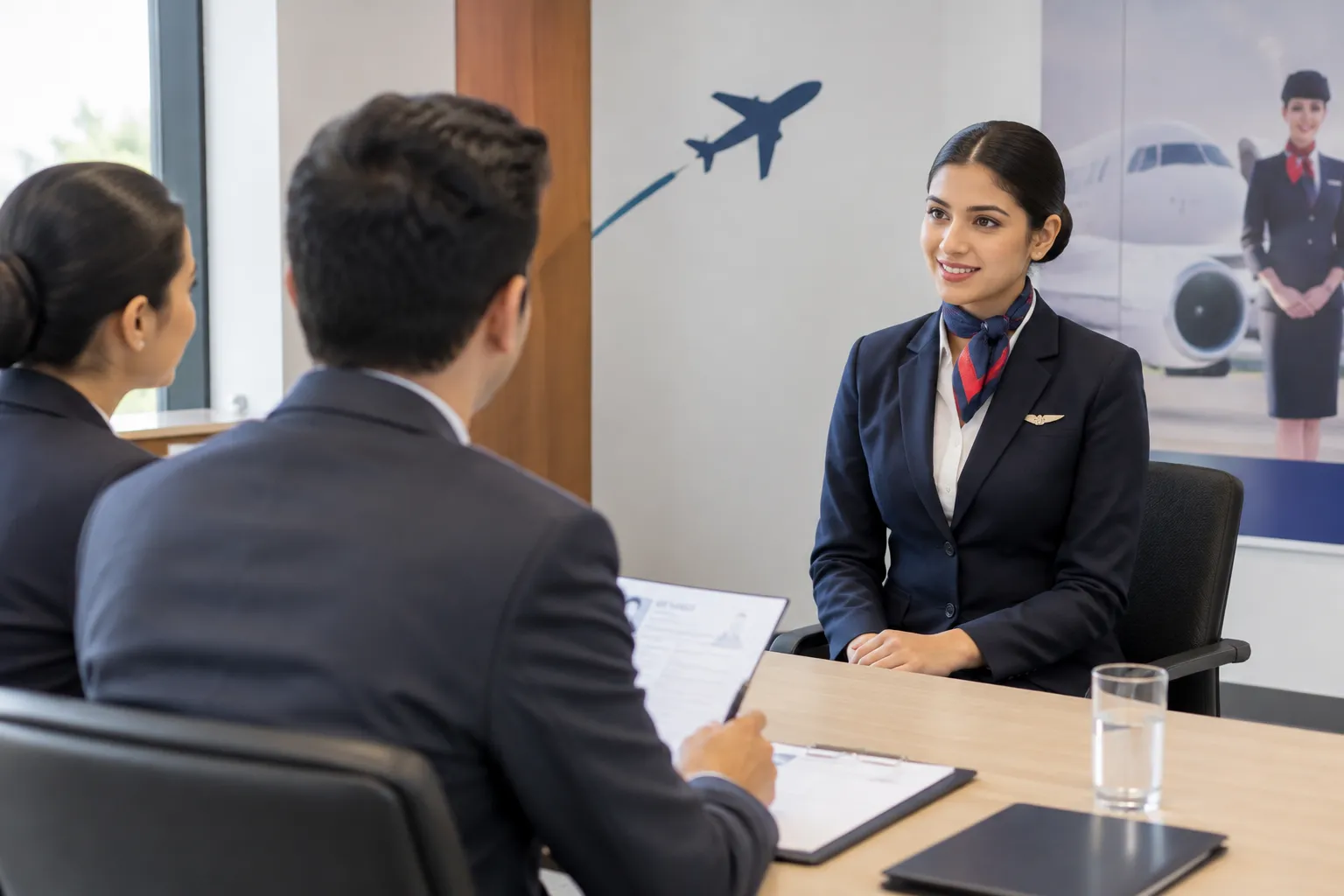
Many students assume recruiters only want candidates with excellent English.
While communication is important, it's only one part of the selection process.
Recruiters generally look for candidates who demonstrate:
Airport operations can become fast-paced, especially during delays or peak travel periods.
That's why recruiters value candidates who remain composed while assisting passengers.
Different airlines and airport service providers may follow different recruitment processes, but interviews often include several stages.
Your application is reviewed to confirm that you meet the basic eligibility requirements.
Candidates may introduce themselves and answer a few basic questions.
Recruiters observe confidence, communication and professional presentation.
Some organisations include group activities to evaluate:
Remember, recruiters don't necessarily choose the person who speaks the most.
They also appreciate candidates who listen respectfully and encourage teamwork.
This stage usually focuses on:
The detailed questions we'll discuss in Part 2 are designed to help you prepare for this stage.
Successful candidates may be asked to submit original documents for verification.
Depending on the employer, medical examinations or additional formalities may follow.
Prepare your documents at least one day before the interview.
Carry them neatly in a professional folder.
Suggested documents include:
Being organised demonstrates professionalism.
.webp)
Recruiters begin forming an impression before the interview starts.
Professional grooming helps create a positive first impression.
Professional grooming reflects discipline and attention to detail.
Avoid these common mistakes:
Small habits can leave lasting impressions.
Avoid trying to memorise new answers at the last minute.
One habit I encourage students to develop is observing airport staff whenever they travel.
Notice how they greet passengers, solve problems and remain polite even when the airport is busy.
Many professional habits can be learnt simply by watching experienced people at work.
Students sometimes tell me,
"Sir, I'm afraid I'll make a mistake during the interview."
My answer is always the same. Everyone makes mistakes.
Interviewers don't expect perfection. They expect professionalism.
If you don't understand a question, politely ask for clarification.
If you don't know an answer, admit it honestly instead of guessing.
Professional behaviour often creates a stronger impression than trying to appear perfect. That's one of the biggest lessons I've learnt from years of conducting mock interviews.
Before we begin, remember one important thing.
The sample answers below are examples to help you understand the structure of a good response. Avoid memorising them word for word.
Recruiters appreciate candidates who sound genuine, confident and natural.
The best answer is always one that reflects your own personality while remaining professional.
.webp)
This is usually the opening question. Recruiters want to assess your confidence, communication skills and your ability to introduce yourself professionally.
A simple format works well:
"Good morning. My name is Rahul Das. I recently completed my Class XII and have always enjoyed interacting with people. During my school years, I participated in group activities and presentations, which helped improve my communication and teamwork skills. I'm interested in working as Airport Ground Staff because I enjoy helping people and would like to build a professional career in the aviation industry."
Common Mistakes
They want to understand your motivation and whether you know what the role involves.
Mention:
"I enjoy interacting with people and solving problems. Working as Airport Ground Staff would allow me to assist passengers while being part of the aviation industry. I also appreciate that the role offers continuous learning and opportunities for career growth."
Common Mistakes
They want to know whether you've researched the role.
Mention responsibilities such as:
Sample Answer
"Airport Ground Staff assist passengers throughout their airport journey. Their responsibilities include check-in, boarding assistance, answering passenger queries, coordinating with different departments and helping ensure airport operations run smoothly."
Common Mistakes
They want to understand the value you'll bring to the organisation.
"I believe my communication skills, positive attitude and willingness to learn would allow me to contribute effectively to your team. I enjoy helping people, remain calm during challenging situations and work well with others."
Common Mistakes
"My biggest strengths are patience and communication. I remain calm while speaking with people and enjoy working as part of a team. I also believe in continuously improving through feedback."
Common Mistakes
To see whether you're self-aware and willing to improve.
"I used to become nervous while speaking in front of large groups. To improve, I started participating in presentations and communication activities. Although I'm much more confident today, I continue practising regularly."
Common Mistakes
Customer service is one of the most important parts of the job.
"I would first listen without interrupting. I'd acknowledge the passenger's concern, remain calm and explain the available options politely. If the issue required additional support, I would involve my supervisor according to company procedures."
Common Mistakes
They want to assess your problem-solving skills and customer service approach.
"I would remain calm and provide passengers with accurate information as soon as it became available. I would answer questions politely, avoid making promises I couldn't keep and follow the airline's procedures while assisting passengers."
Lost baggage situations require patience and professionalism.
"I would listen carefully to the passenger, collect the necessary information and reassure them that I would follow the correct baggage reporting process. Throughout the interaction, I would remain polite and keep the passenger informed."
Common Mistakes
Best Structure
Use the STAR Method:
Sample Answer
"During our school annual function, I was part of the organising committee. My responsibility was coordinating with other volunteers and ensuring guests were welcomed properly. By communicating regularly and helping each other, our team organised the event successfully. That experience taught me the value of teamwork."
Always remember these five habits:
Many students believe interview success depends on speaking perfect English.
In reality, recruiters appreciate candidates who communicate clearly, remain respectful and stay calm under pressure.
Simple English spoken confidently often creates a better impression than complicated English spoken nervously.
Whenever we conduct mock interviews at Edugree, I remind students that an interview is not an exam where only one answer is correct.
It's a conversation.
Recruiters are trying to understand how you think, how you communicate and how you would interact with passengers.
If you answer honestly, listen carefully and remain professional, you've already demonstrated some of the qualities the aviation industry values most.
In many interviews, recruiters ask a series of short questions to evaluate how naturally you communicate.
Don't try to give long answers.
Be calm, clear and professional.
1. What does customer service mean to you?
Providing polite, professional and timely assistance while ensuring every passenger has a positive experience.
2. Are you willing to work in shifts?
Yes. I understand that airports operate 24 hours a day, and I'm comfortable working rotational shifts, including nights, weekends and public holidays.
3. What would you do if a passenger became angry?
I would remain calm, listen carefully, empathise with the passenger and follow company procedures while trying to resolve the issue professionally.
4.Are you comfortable standing for long hours?
Yes. I understand that airport operations require physical stamina, and I'm prepared for the demands of the job.
5.Can you work under pressure?
Yes. I believe staying calm, organising priorities and communicating clearly help manage pressure effectively.
6. What would your friends say about you?
They would describe me as dependable, patient and easy to work with.
7. Why do you want to work in aviation?
Because I enjoy helping people, working in a professional environment and being part of an industry that connects people across the world.
8. How do you deal with difficult situations?
I remain calm, understand the situation carefully, communicate respectfully and focus on finding an appropriate solution.
9. What is teamwork?
Teamwork means working together towards a common goal while supporting colleagues and communicating effectively.
10. Are you willing to relocate?
Yes. I understand that aviation careers often require flexibility, and I'm open to relocation if needed.
11. How would you greet a passenger at the check-in counter?
"Good morning. Welcome. May I have your ticket and identification, please?"
A polite greeting creates a positive first impression.
12. What would you do if you didn't know the answer to a passenger's question?
I would never guess. I would politely inform the passenger that I will verify the information and provide the correct answer as soon as possible.
13. What motivates you?
Learning new skills, helping people and continuously improving myself professionally.
14. Why should we select you?
Because I have a positive attitude, enjoy interacting with people, communicate professionally and am willing to learn and grow within the organisation.
15. Do you have any questions for us?
Always ask something meaningful.
For example:
"What qualities do your most successful Ground Staff employees have?"
It reflects curiosity and genuine interest.
Recruiters begin observing you from the moment you enter the venue.
During the Interview.
Professional body language often speaks before you do.
Remember, professionalism begins before the interview starts.
Over the years, I've noticed a few mistakes that many students make.
Try to avoid them.
One imperfect answer will not usually cost you the interview.
Losing your professionalism might.
.webp)
Every airport professional started as a beginner.
After completing Class XII from St. James School, Binnaguri, Krinjal joined Edugree with the dream of working in aviation.
Through regular communication classes, mock interviews and practical training, she gradually became more confident.
Today, she is proudly associated with IndiGo Airlines, showing how consistent preparation can open exciting career opportunities.
Pushpanjali Gurung completed her schooling at Prashanti Vidya Mandir, Gangtok.
She worked consistently on her communication skills, personality development and interview preparation throughout her training.
Today, she is also flying with IndiGo Airlines, inspiring students from Sikkim and neighbouring regions to pursue careers in aviation.
Their journeys remind us that confidence is developed through practice, patience and perseverance.
Students often ask me,
"Sir, what is the one quality that every recruiter notices?"
My answer is simple.
Professional attitude.
A candidate who listens carefully, speaks respectfully, remains calm and shows a willingness to learn often leaves a stronger impression than someone trying to sound perfect.
Knowledge can be taught. Attitude is demonstrated.
Develop good habits during your training, and they'll naturally appear during your interview.
At Edugree Institute, interview preparation is built into the learning process—not treated as a one-day session.
Our Certificate in Aviation helps students develop the practical skills employers look for.
To help students become well-rounded professionals, Edugree also offers:
One principle we emphasise throughout the course is:
"Passengers may forget what you said, but they'll always remember how you made them feel."
That's why we encourage every student to develop professionalism, empathy and confidence—not only for interviews but for a successful career in aviation.
If you're planning a career as Airport Ground Staff or Cabin Crew, you're welcome to visit Edugree Institute, Siliguri for career counselling.
Our team will help you understand different aviation career options, explain the training process and guide you towards the path that best matches your goals.
Edugree Institute, Siliguri
Call / WhatsApp: 8001554321
You may also find these guides helpful:
Soham Dasgupta
Director, Edugree Institute.
Soham Dasgupta is the Director of Edugree Institute and has been mentoring students for careers in aviation, hospitality and communication for several years. Through career counselling, classroom training and mock interview sessions, he has helped hundreds of students develop the confidence, communication skills and professional mindset required to begin successful careers in the aviation industry.
.png)


